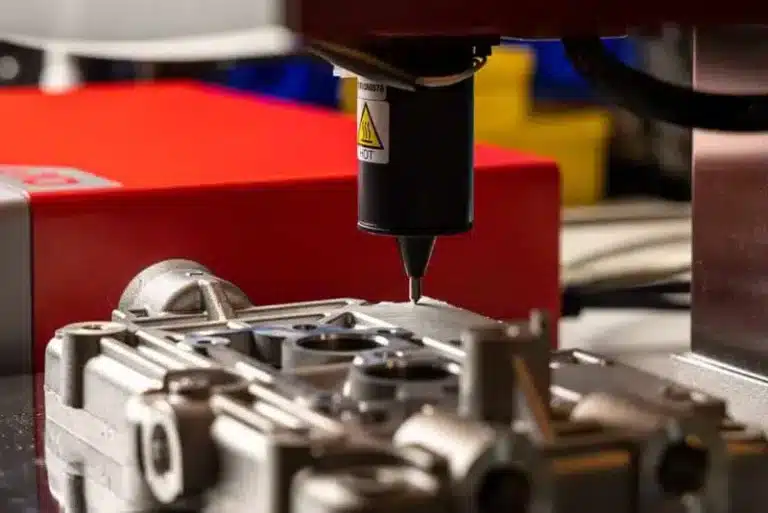
The choice of a marking technology in the context of industrial traceability is based on a rigorous analysis of technical criteria such as the nature and density of the identifier, durability against abrasion and chemical agents, constraints related to the material and part geometry, as well as reading requirements and production rate requirements. In this context, laser marking is preferred when information density and production speeds are high, dot peen marking is selected when mechanical resistance and identifier durability are critical, and scribing is suited to simple identifiers requiring direct human-readable marking.
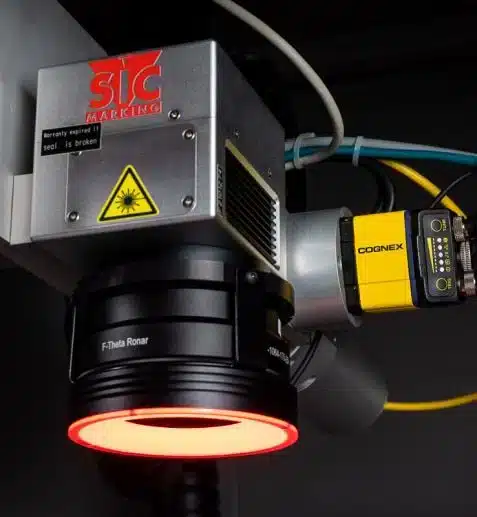
The choice between plain text, a long serial number or a 2D code directly determines the marking technology to be selected.
A Data Matrix code requires high information density, controlled geometry and contrast compatible with automatic reading, whereas an identifier intended primarily for human reading can be produced using a simpler marking method, such as shallow scribing.
The expected durability of the identifier — resistance to abrasion, cleaning operations or chemical agents — as well as the material type (steel, stainless steel, aluminum, engineering plastics, anodized or painted surfaces) then guide the balance between contrast, depth and long-term durability.
In this context, dot peen marking is selected when mechanical resistance and marking permanence are priorities, laser marking when precision and information density are decisive, and scribing for short information requiring direct readability.
The material, surface characteristics and part geometry guide the choice between laser marking, dot peen marking and scribing.
High-density 2D codes require precise geometry and good compatibility with automatic reading, which favors laser marking, while identifiers exposed to abrasion, impacts or chemical agents favor dot peen marking, thanks to its mechanical recessed marking.
Geometry (flat, cylindrical or complex surfaces) and accessibility of the marking area may also impose integration constraints that exclude certain technologies.
The expected durability of the identifier and subsequent processes (painting, heat treatments, additional machining operations) determine the balance between contrast and depth.
Scribing remains suitable for simple information intended for human reading, laser marking meets the requirements of machine vision reading for high-density identifiers, and dot peen marking provides the highest long-term mechanical robustness.
Surface coatings and treatments can enhance or limit contrast and marking durability, making it necessary to define the process at the product design stage to ensure lasting readability throughout the entire service life.
The actual durability of an identifier over the service life of the part depends on the combination of operating constraints: abrasion, chemical agents, temperatures and subsequent processes.
In an industrial context, it is common to require a high and stable reading rate, which makes it necessary to assess not only the intrinsic robustness of the marking (depth, contrast, adhesion), but also its compatibility with production rates, automated integration and the nature of the materials (stainless steel, aluminum, engineering plastics, treated surfaces).
These choices have a direct impact on the total cost of traceability: a durable marking limits unreadable codes, rework and costly investigations, particularly when direct part marking or multi-year readability requirements apply.
Marking technologies are therefore selected based on real-use scenarios — chemical exposure, thermal cycles — in order to define the appropriate balance between depth, contrast, positioning and process (laser, dot peen or scribing).
In harsh environments, dot peen marking is generally preferred for its high mechanical resistance, while laser marking is selected for high-density identifiers requiring reliable automatic reading, provided sufficient durability is ensured for the material and selected process.
Subsequent processes (painting, anodizing, heat treatments, additional machining operations) are systematically taken into account to ensure that the marking retains its readability after aging. Representative testing and measurable criteria (ISO 29158 standard, reading rate after cycles, minimum depth) make it possible to align the technological choice with industrial constraints and sustainably reduce the risk of non-compliance or product recalls.
Marking and Reading Performance
The depth, contrast and marking resolution directly determine the longevity of readability and the reading rate in production.
High-density 2D codes require controlled geometry and a module size compatible with automatic reading, which favors laser marking, while dot peen marking provides greater depths ensuring better resistance to abrasion, cleaning, and harsh environments.
Scribing remains suitable for simple identifiers intended primarily for human reading.
High-speed automated production lines favor laser marking for its repeatability and compatibility with machine vision.
Sector-specific requirements imposing high reading rates over the product’s service life reinforce the need for a carefully balanced compromise between code density, contrast, depth, and type of reading solution.
The choice of marking technology in production is strongly influenced by production speed, level of automation, and integration ergonomics.
High-speed production lines and high-density identifiers favor laser marking for its speed and compatibility with machine vision, while dot peen marking is selected when mechanical durability is the priority at moderate speeds.
Scribing remains suitable for simple markings and primarily manual applications.
Positioning stability, accessibility of the marking area, and part geometry directly affect readability and reading rate.
For small, inclined, convex or concave surfaces, tooling adaptations, indexing, or a 3D laser option may be required. Integration must therefore be validated through representative testing, including operational and production conditions, to ensure reliable marking and reading.
The choice of a marking technology must take into account the total cost of ownership, including investment, operation, and reading devices.
The unit cost depends on production speed and level of automation: laser marking is suitable for high-speed lines and automated unit traceability, dot peen marking for moderate speeds when robustness is the priority, and scribing for simple and manual applications.
The cost of unreadable codes, often higher than the additional cost of a more durable marking, must be considered in the analysis.
Regulatory and industry-specific requirements also guide the technological marking choice.
Constraints related to direct part marking (DPM), code quality, and traceability favor laser marking for high-density identifiers readable automatically, or dot peen marking when mechanical and chemical durability is critical. These requirements imply verification procedures and marking compatibility with materials and surface treatments to ensure compliance and readability over the entire service life of the part.
When selecting a permanent marking technology, priority should be given to readability by reading systems, identifier durability over the entire lifecycle, actual cost related to unreadable codes, and integration constraints in production, rather than one-off or purely aesthetic criteria.
Neglecting these parameters often leads to rework, production line disruptions, and partial or degraded traceability.
When a fiber laser marking is selected for marking components in stainless steel, it generally provides high contrast and production-compatible speeds, while ensuring good compatibility with automatic reading.
However, this marking technology may be less suitable for certain materials, where contrast or long-term durability do not meet traceability requirements.
Conversely, an improperly sized dot peen marking — due to part surface condition, unsuitable geometry, or lack of preliminary testing — can compromise identifier readability, especially for small 2D codes.
It is therefore essential to compare, for each application, material compatibility, the actual appearance achieved, minimum marking depth when durability is critical, as well as effective production speed under industrial conditions, to avoid unreadable codes in production.
Part geometry and accessibility of the marking area also influence the choice: mechanical marking requires a stable surface and sufficient clearance for the tool, while laser marking imposes focal distance constraints.
Finally, consideration of the reading chain is essential: without automatic reading tests conducted under real production line conditions (lighting, speed), the reading rate achieved may deviate significantly from expected targets.
When a marking is validated only at the end of the line, without taking into account subsequent processes, traceability may be compromised.
The subsequent processes that parts may undergo include:
Paint can partially fill the cavities of recessed markings and reduce 2D code contrast, heat treatment can diminish a laser marking made by surface annealing, and repeated abrasion (industrial cleaning, friction) can degrade shallow markings.
It is therefore essential to define acceptance criteria after each process step — target reading rate, measured contrast, residual depth — and to require representative tests before industrialization.
In practice, the least expensive marking solution in terms of investment is not always the most cost-effective over the lifecycle.
A deeper mechanical marking or a properly parameterized laser marking may incur an initial extra cost, but ensures a high reading rate after painting, corrosive exposure, or aging, thus reducing the risk of rework and recalls.
It is recommended to formalize a qualification protocol including subsequent processes such as sandblasting/shot blasting, heat treatment, KTL / cathodic dip coating or e-COAT, baking, corrosion tests, and abrasion cycles to objectively measure readability loss and assess the associated industrial risk.
Before final validation, tests under near-production conditions must be conducted: marking, subsequent processes, then reading control with line equipment.
This approach allows identification during the pilot phase whether the selected marking technology and defined parameters (depth, contrast, positioning) ensure durable traceability or if adjustments are needed.
A markable area that is too small, inclined, or difficult to access (bores, grooves, curved surfaces) requires specific technical choices regarding optics, the compactness of the marking head, and positioning.
On cylindrical parts or non-flat surfaces, using a 3D option helps preserve the marking geometry and the contrast needed for automatic reading.
From the part design stage, it is recommended to identify and reserve a dedicated flat and accessible area for marking. This area can be integrated and documented in CAD models and drawings to avoid costly adaptations during industrialization.
Experience shows that simply repositioning the marking on a more favorable face can significantly improve the reading rate and simplify production integration, while reducing constraints and automation costs.
Synchronization with the production line speed requires that the marking time be compatible with the production flow.
At high speeds, it is necessary to choose solutions capable of marking on the move — MOTF (Marking on the Fly) or in-motion marking — or to reduce exposure time to meet the available cycle windows.
Positioning stability must be defined according to the resolution of the identifier to be marked.
The higher the code density, the stricter the required repeatability to ensure reliable automatic reading.
Requirements for traceability are not limited to the immediate readability of the marking. They involve compliance with code qualification frameworks (ISO 29158 for DPM marking) as well as GS1 specifications for identifier structuring.
Depending on the industry, these requirements may also fall under regulatory or normative frameworks such as UDI for medical devices, or IATF 16949 and AS9100 standards for the automotive and aerospace sectors.
In this context, code quality criteria (cell size, contrast, reading score) may be imposed by clients, and non-compliance often results in rejections during supplier audits.
Compliance must be ensured throughout the entire product lifecycle.
Industry requirements may impose specific identifier formats, minimum readability durations, and high reading rates in production.
In practice, these constraints translate into the implementation of documented validation procedures, including marking qualification reports, code quality checks, and endurance tests (corrosion, abrasion, thermal cycles), to demonstrate that the selected marking solution remains compliant under representative usage conditions.
Summary
The choice of a marking technology for traceability relies on an overall technical trade-off.
It must take into account the nature of the identifier, the expected durability over the entire lifecycle, material-related constraints, readability by reading systems, production integration, and the applicable regulatory requirements.
Conducting representative tests, defining measurable acceptance criteria, and evaluating the actual cost of unreadable codes are crucial to ensure robust traceability, usable, and compliant over time.
Contact Us
Need information?