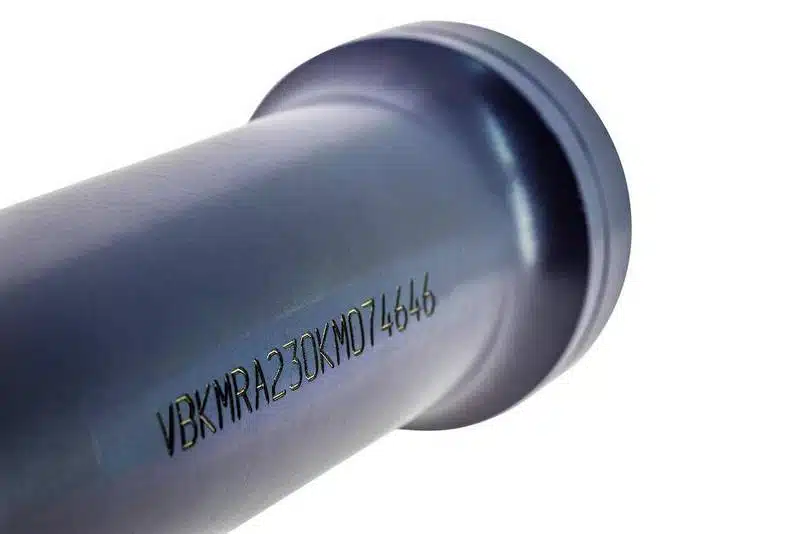
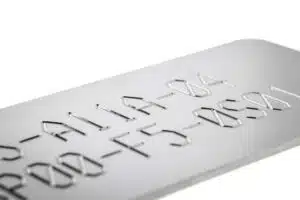
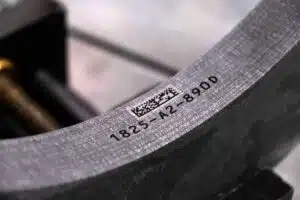
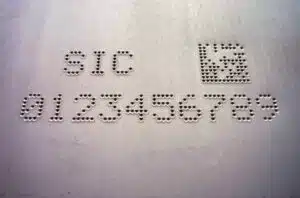
Dot peen marking is a proven marking technology that delivers permanent identification of parts through deep marking with lasting durability.
The process forms a deep, indented mechanical mark that stays legible over the long term, even after standardised abrasion tests, impact resistance testing or industrial washing cycles.
Dot peen marking answers long-term traceability demands by enabling serial numbers, part references and DataMatrix codes to be marked straight onto the component, delivering accurate, repeatable reading by machine vision systems, even following surface treatments or in the harshest industrial environments.
Dot peen marking involves setting several parameters (impact force, dot density, stylus angle, stylus-to-part distance, marking speed) to suit the material and its surface condition.
From handheld applications through fixed production environments to automated systems, SIC MARKING supplies solutions to match every industrial sector.
This versatility, and the scope to fine-tune marking parameters to each material and requirement, make dot peen marking a key technology for reliable identification, lasting traceability and maximum resistance to demanding conditions.
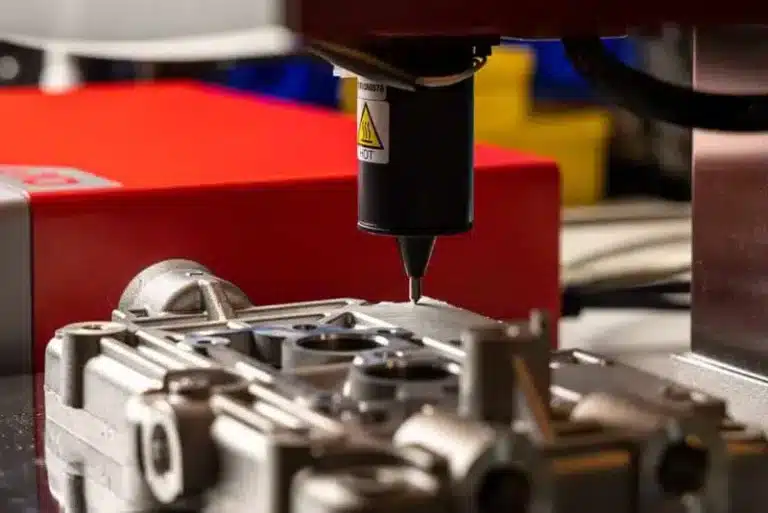
Using a controlled impact, the dot peen marking machine builds up a sequence of impact dots that form a durable indented mark.
The impact force is set to deliver the target depth.
In practice, typical depths run from a few micrometres to several hundred micrometres, depending on the material and the application.
The marking density can likewise be fine-tuned by changing the spacing between the impact dots.
Dot peen marking is a highly productive marking solution across a very wide range of parts, whether flat, cylindrical, complex, small, large, or with restricted-access areas.
It delivers precise, durable marks every time.
Its flexibility means this marking technology copes with any part geometry and size, producing repeatable, dependable marks for identification, traceability and industrial compliance alike.
The right marking solution (static dot peen marking station, handheld dot peen marking machine, integrated dot peen marking units and accessories such as a rotary axis or bespoke fixtures) comes down to several factors: part shape, accessibility and production volume. Every situation warrants a tailored approach to secure the best possible mark.
Batch Production
For batch production, the recommended choice is the static dot peen marking station. Its stability and precision make it the right fit for high-volume output. This type of station keeps marking fully repeatable and suits production environments where marking consistency and quality drive uptime and yield.
Heavy or Fixed Parts
For heavy or fixed parts, the recommended choice is the handheld marking machine. This equipment brings the mobility needed to mark parts that cannot readily be moved. It comes into its own for on-site jobs or environments where flexibility and the ability to work directly on the component count most.
Complex Shapes
For complex shapes, the recommended choice is to work with rotary axes. These rotary axes or bespoke fixtures reach restricted-access areas and secure an effective mark on parts with complex or irregular profiles. They bring greater accessibility and tight precision, even on curved surfaces or oversized parts.
Dot peen marking performs particularly well on ferrous metals (such as carbon steels, stainless steels and cast irons) and on non-ferrous metals (such as aluminium, copper and their alloys), together with certain rigid engineering polymers such as POM, PA and PEEK, whose impact resistance is high enough to secure a durable mark.
Ferrous Metals
On carbon steels, dot peen marking delivers a durable, wear-resistant mark, well matched to serial numbers on chassis members and structural parts after machining or heat treatment.
Stainless steels (304, 316, ferritic, martensitic) likewise take this process well, yielding legible marks that come through abrasion and corrosion testing in industrial settings.
On solid iron alloys such as grey or ductile cast iron, the material is robust enough to accept deep marks with no risk of cracking, an ideal match for engine blocks and heavy components. Parameters are set to hold repeatability steady across the whole batch.
Non-Ferrous Metals
On aluminium (alloys in the 5xxx, 6xxx, 7xxx series), dot peen marking achieves precise marks on the softer surfaces found in aerospace and automotive manufacturing.
With copper and copper alloys (brass, bronze), dialling back the impact force is recommended to keep deformation in check and preserve optimal legibility.
Engineering Polymers
Engineering polymers such as ABS, POM, PA and PEEK take dot peen marking well, given their suitable rigidity and sound dimensional stability. Setting the force to reach marking depths of 10 to 100 µm and fitting 60° angle styluses is all it takes to keep legibility spot on.
In service, permanent marks are placed on electronic housings, POM gears, and PA engine parts to underpin traceability.
Unsuitable Materials
Soft plastics such as TPE, EPDM and silicones are, as a rule, unsuitable for dot peen marking. A Shore A hardness under around 50 leads to elastic deformation rather than a crisp indentation.
Equally, ceramics, and materials that are very thin or brittle, are liable to crack or shatter under the mechanical impact.
Dot peen marking handles a comprehensive set of mark types, spanning alphanumeric marks, 1D/2D codes and regulatory marks as well as technical references and deep marks, securing permanence, legibility and resistance under demanding conditions.
As dot peen marking machines adapt to varied materials and complex geometries, this permanent marking technology lets the depth and position of marks be tuned to fit machining constraints, assembly demands and environmental conditions.
Chiefly used for serial numbers, part references and identification codes, alphanumeric marking by dot peen lays down strings of characters at a set height and to controlled depths, matched to the material.
This marking stands up to industrial conditions including abrasion, high temperatures and chemical attack, whilst staying legible for human reading and automated reading alike.
Dot peen marking produces 2D matrix codes such as the DataMatrix, well matched to a very wide range of surfaces.
The DataMatrix comes into its own where information density counts, typically in the aerospace and medical sectors.
The DataMatrix ECC200 is the benchmark for industrial components, prized for its robustness and compactness.
Dot peen marking meets the traceability and identification demands set out in sector regulations, such as EU Regulation 2017/745 (MDR) for medical devices and the UDI rules issued by the FDA, along with quality standards such as ISO 9001, ISO 13485 or IATF 16949 in the automotive industry. Such marks must typically stay permanent, legible after ageing and able to withstand abrasion or corrosion testing.
Dot peen marking technology reaches marking depths of a few micrometres up to several hundred micrometres, enough to come through standardised tests such as the salt spray test to ISO 9227 in certain cases.
Dot peen marking drives marks deep into the material, making it ideal for serial numbers on metal parts, codes on engines and industrial tooling. These marks carry typical depths set by the material and the marking parameters, keeping them legible even after machining, painting, shot blasting or heat treatment.
Dot peen marking underpins lifetime traceability, a prerequisite for regulatory compliance (including UDI requirements and automotive traceability) and for maintenance.
Across the automotive sector, dot peen marking is used to apply serial numbers, barcodes and part references to metal parts and engine components. It secures the traceability and durability demanded by high-rate production environments, where marks must come through heat treatment and surface treatments such as shot blasting or painting. The technology suits applications including body panels, engine blocks, and structural members, where constant legibility underpins compliance and long-term maintenance.
Within the aerospace industry, dot peen marking identifies engine components, metal structures and critical parts deployed on aircraft. Marks are applied to secure end-to-end traceability along the production chain and through maintenance inspections. The precision of dot peen marking permits serial numbers or DataMatrix codes on parts working under extreme conditions, spanning metal components, brackets, casings, structural parts, whilst holding to strict compliance and safety standards such as AS9100.
Within the rail industry, dot peen marking identifies bogie components, nameplates and structural parts such as rails or braking systems. These marks are central to keeping parts traceable and to their maintenance over time, securing swift identification across complex production and servicing settings. Marked codes are commonly tied to serial numbers or 2D codes to ease stock management and compliance checks across the full working life of the equipment.
Within the electronics industry, dot peen marking identifies electronic components such as electronic housings, metal chassis and nameplates. These marks are central to part traceability through the production line and ease repairs or modifications in service. DataMatrix codes can be marked too, as they hold information on small, intricate surfaces, keeping legibility and durability intact even after rigorous testing or heat treatments.
Browse our flagship dot peen marking equipment: handheld machines, modules for production line integration or stand-alone marking stations.
Contact us
Need further information?
Talk to one of our experts!