A cornerstone material across industry, steel stands out for its unique balance of hardness, ductility, thermal conductivity and corrosion resistance — properties that vary according to its composition.
An iron-carbon alloy enhanced with alloying additions, it offers exceptional adaptability through heat treatment processes (quenching, tempering, annealing) and the incorporation of alloying elements to optimise performance for specific operational demands.
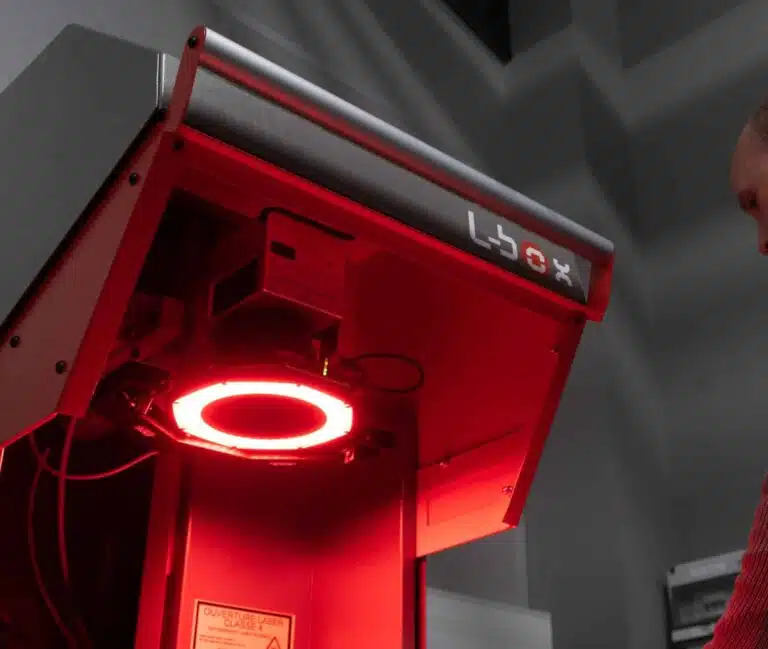
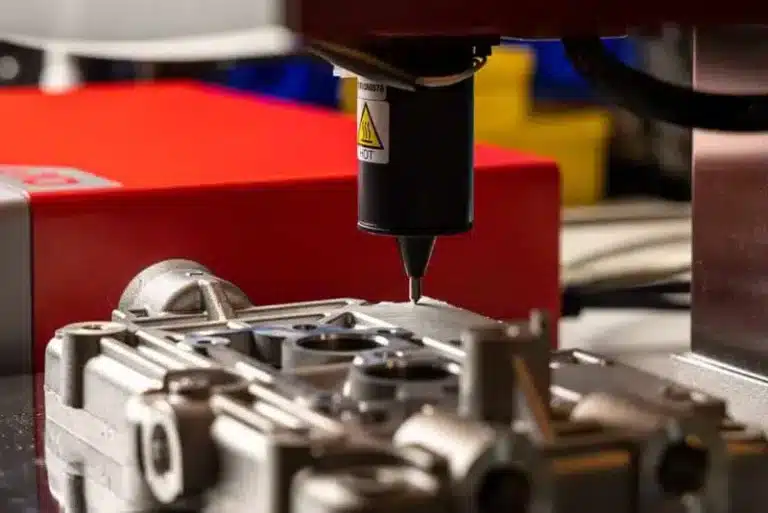
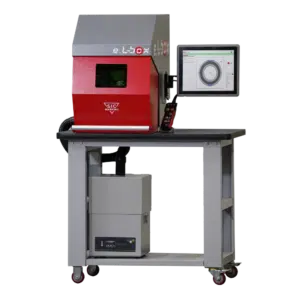
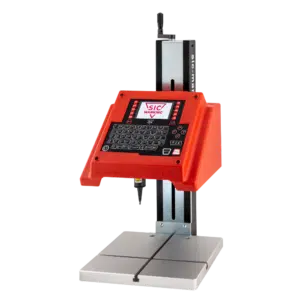
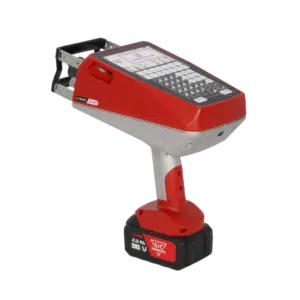
Depending on steel hardness, surface finish, production environment or the required marking type (Datamatrix, serial number, deep marking…), SIC MARKING offers several families of steel marking machines:
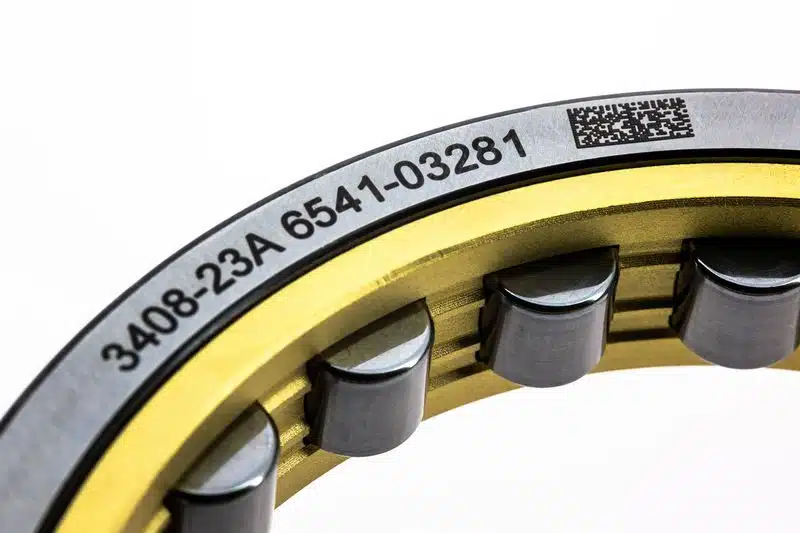
Selecting the right marking technology for steel industrial parts depends on several key factors: hardness, surface finish, composition, thickness, thermal sensitivity and the required contrast level.
Steel’s homogeneous surface, its excellent absorption of the laser beam, its outstanding impact resistance for dot peen marking and its wear resistance for scribing marking make it an ideal substrate for the most demanding marking requirements.
Steel guarantees optimal machine-readable quality for Datamatrix and QR codes, high durability in harsh operating environments, and full compatibility across all surface finishes.
Steel is compatible with all types of permanent marking: alphanumeric characters, 2D codes (Datamatrix), QR codes, barcodes, logos and deep marks.
The choice of steel marking technology depends on the specific application and any post-marking treatments planned, such as painting, galvanising or further machining operations.
Laser marking on steel delivers high resolution and exceptional contrast, dot peen marking on steel ensures outstanding mark permanence and mechanical robustness, whilst scribing achieves a deep, durable mark profile suited to the most demanding wear and traceability requirements.
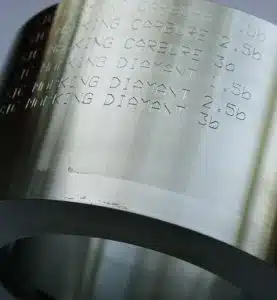
Alphanumeric marking forms the foundation of industrial traceability: serial numbers, batch numbers, part identifiers, internal references and variable data such as date, time or production counters. Serial numbers typically range from 6 to 12 characters, whilst internal references commonly fall between 4 and 10 characters.
As a general rule, character heights of 2 to 5 mm are used for comfortable human readability, with smaller sizes (0.3 to 1 mm) specified for automated vision reading systems.
In practice, laser marking is the standard solution for Datamatrix code marking; it remains the reference technology for marking steel after painting and for compliance with DPM requirements on demanding part specifications.
When selecting a steel marking technology, key factors include surface condition (bright, brushed or painted), required mark depth, and integration with vision inspection systems and ERP platforms.
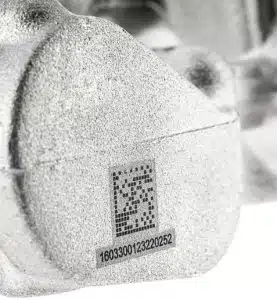
Datamatrix ECC200 codes, widely deployed across automotive, aerospace and pharmaceutical industries, enable a high density of information to be encoded within a very small footprint (2 to 10 mm).
When correctly configured, they remain machine-readable after painting or galvanising, with cell modules typically ≥0.25 mm to ensure reliable vision system verification.
On steel, performance is outstanding: thousands of parts can be marked with read rates consistently exceeding 99%. In production environments, these codes integrate directly with process control systems and tracking tools such as MES platforms, streamlining logistics management and maintenance operations.
Moins utilisés que les Datamatrix, les QR codes restent appréciés lorsqu’une lecture smartphone/tablette est souhaitée. Leur grande capacité (jusqu’à plus de 4 000 caractères) permet d’encoder directement URL et informations détaillées.
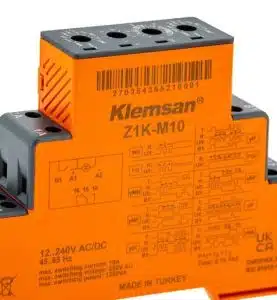
1D barcodes remain widely used for the linear identification of steel parts, particularly in logistics operations and spare parts management.
The most common formats — Code 128, Code 39 and EAN — are capable of encoding between ten and twenty characters.
Laser marking on steel with a bar width of 0.15 to 0.25 mm consistently ensures reliable scanner readability.
They are well suited to assembly lines equipped with fixed short-range readers. Laser marking enables high-speed output (up to 1 to 2 codes per second), whilst dot peen marking, though slower, offers superior mark durability in abrasive or harsh operating environments.
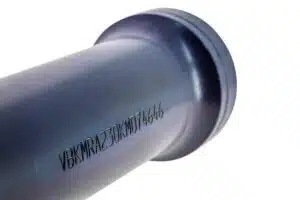
For applications where long-term durability is paramount, deep marking is the reference solution: marks remain legible after machining, painting, shot-blasting or galvanising.
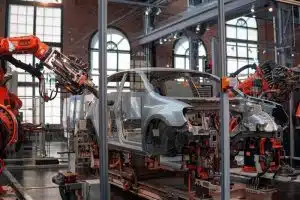
In the automotive sector, deep marking is primarily used for VIN marking on chassis, where mark continuity and depth are critical for regulatory compliance and anti-fraud requirements.
In steel construction and offshore applications, structural beams and flanges are deep-marked to remain legible after shot-blasting and painting, whilst withstanding thermal cycling and corrosive environments.
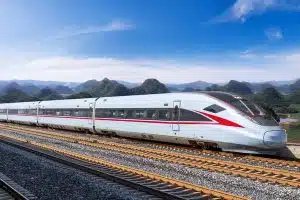
The rail industry and machine tool sector also rely on deep marking for forged parts and safety-critical components, with minimum mark depths specified within contractual and normative requirements. These robust permanent marks guarantee long-term traceability and eliminate the risk of costly part replacement.
In practice, the selection of the permanent steel marking technology is driven by operational constraints: scribing is preferred for forged components destined for shot-blasting, whilst dot peen marking is well suited to parts that will subsequently be painted.
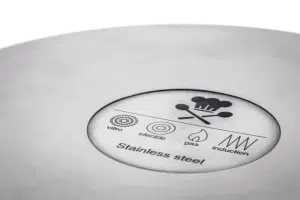
The choice is also determined by end-use requirements: pictograms that must remain visible after painting are frequently produced by dot peen marking, whilst compliance symbols require the precision and contrast that only laser marking can reliably deliver.
Steel, by virtue of its robustness, hardness and dimensional stability, is ideally suited to permanent marking by laser marking, dot peen marking or scribing. These steel marking technologies ensure lasting legibility even in the harshest operating environments, whilst meeting the compliance requirements of the automotive, aerospace, rail, energy, medical and defence sectors.
Depending on the application, marking can be deep, high-contrast or extremely fine-detail to meet specific industrial constraints and traceability requirements.


Explore our flagship laser, dot peen and scribing marking solutions, across our range of portable machines, production line integrated modules and standalone marking stations.
Get in Touch
Need further information?
Speak to one of our marking experts today.