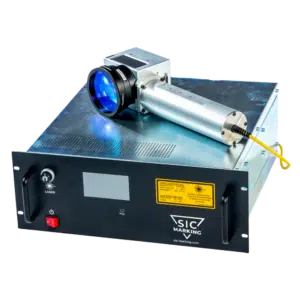
Plastic components now sit at the heart of countless industrial applications. Across automotive, electronics, medical, aerospace, and electrical equipment, engineering polymers continue to displace metals on account of their light weight, resilience, and straightforward processing.
Laser marking plastic makes it possible to identify every plastic component permanently, with no contact, no ink, and nothing consumed in the process.
Subject to the characteristics of the material, the laser beam can achieve a high-contrast marking, a surface engraving, or a fully legible colour change, whilst leaving the integrity of the component untouched.
The quality of any plastic laser marking operation nonetheless rests on numerous variables. The choice of polymer (ABS, polycarbonate, polyamide, PEEK, PBT, POM…), the colour of the material, the additives present, the mineral fillers or glass fibres, together with the performance of the laser system, all bear directly on the contrast obtained, code legibility, and the long-term resistance of the marking.
As an industrial marking specialist, SIC MARKING works alongside manufacturers to pin down the technology that best fits their applications, drawing on established expertise in plastic materials and industrial traceability
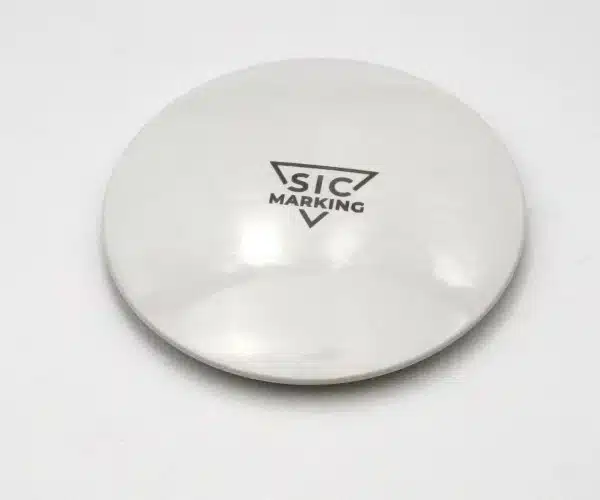
Laser marking plastic delivers against these requirements by producing a permanent, accurate identification carried by the plastic component itself.
Where labels, inkjet prints, or applied markings fall short, it consumes nothing and holds its legibility through handling, wash cycles, and shop-floor conditions.
Laser marking plastic is suited to a great many of the polymers in everyday industrial use.
Each material nonetheless carries physical and chemical properties of its own that govern its response to the laser beam.
How the polymer is composed, what colour it carries, whether mineral fillers or fibres are present, and which additives entered the mix at manufacture together set the contrast obtained, the standard of the marking, and how long it lasts.
Through precise adjustment of the laser settings, permanent markings can be applied to most of the engineering plastics destined for industrial traceability.
How the polymer is formulated, alongside the pigments, dyes, glass fibres, mineral fillers, and any specialist additives, bears directly on the contrast obtained and the final standard of the marking.
It is for that reason that SIC MARKING runs marking trials to dial in the laser settings for every application.
That validation stage safeguards the legibility of Data Matrix codes, QR codes, serial numbers, and industrial logos whilst the mechanical and cosmetic properties of the plastic components are preserved.
By contrast with metals, laser marking plastic rests on more than one physical phenomenon.
Governed by the nature of the polymer, its colour, the pigments in play, the additives carried within the material, and the beam settings, several mechanisms may be brought to bear to produce a permanent marking.
The aim remains constant: sufficient contrast to keep the marked information legible, with the mechanical and cosmetic properties of the component left untouched.
Governed by the application in view, the laser can drive a colour change, a foaming effect, a surface engraving, or the ablation of a coating.
Chief amongst the advantages of laser marking plastic is its capacity to deliver strong contrast, the bedrock of legible marked information. Governed by the nature of the polymer, its colour, and its formulation, the laser can drive a colour change, a foaming effect, or a fine engraving to bring out a black, white, grey, or sharply contrasted marking.
Set against printing or ink marking, the contrast springs directly from the response of the material to the beam. The outcome accordingly answers to numerous variables, amongst them the composition of the plastic, the pigments in play, the additives introduced at manufacture, and the settings of the laser system.
Drawing on established expertise across materials and industrial traceability, SIC MARKING works alongside manufacturers to pin down the marking settings best suited to every application. Trials run ahead of production sharpen the contrast delivered and safeguard the legibility of Data Matrix codes, QR codes, and further marked information, whilst the mechanical and cosmetic properties of the plastic components are preserved.
Laser marking plastic applies a permanent identification straight onto the component, with neither label nor consumable involved.
On the strength of the tight focus of the beam, alphanumeric characters and intricate 2D codes alike can be marked whilst first-rate read quality is retained.
Governed by production requirements, the marked information underpins the identification of plastic components, production tracking, quality control, and regulatory compliance alike. It can be read by eye or automatically via machine vision systems and handheld scanners.
The terms plastic laser marking and plastic laser engraving are routinely used interchangeably. They nonetheless denote two separate processes answering to distinct objectives.
The decision hangs principally on the demands of the application: cosmetic standard, the contrast level in view, marking depth, resistance to mechanical wear, and the constraints of automated reading.
Laser marking broadly takes precedence for industrial traceability, whilst laser engraving is brought in wherever material removal is called for.
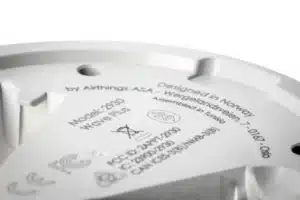
Contrast laser marking reshapes the appearance of the plastic locally whilst next to no material is removed. Under the beam, the polymer surface shifts in colour or structure, throwing up visible contrast against the remainder of the component.
The geometry of the component stays all but unchanged, a decisive advantage for precision components and cosmetic surfaces.
On the strength of the tight focus of the beam, it renders exceptionally accurate markings, ideally suited to automated reading systems and high-rate production.
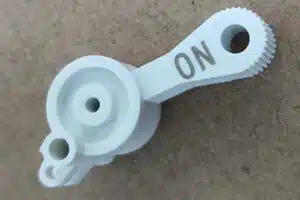
Plastic laser engraving rests on a separate principle. The beam strips out a small quantity of material to raise a relief of variable depth within the polymer itself.
The depth delivered answers notably to:
Engraving comes to the fore wherever the marking must stay visible in the face of repeated friction, frequent cleaning, or heavy mechanical loading.
Laser engraving broadly outperforms a plain surface marking on wear resistance, though it reshapes the surface finish of the component to a greater degree.
Across the bulk of industrial applications, contrast laser marking stands as the favoured route to identifying plastic components. It delivers a first-rate standard of legibility whilst the integrity of the material holds.
Laser engraving, by contrast, is held back for applications demanding a deeper marking or stronger resistance to mechanical wear.
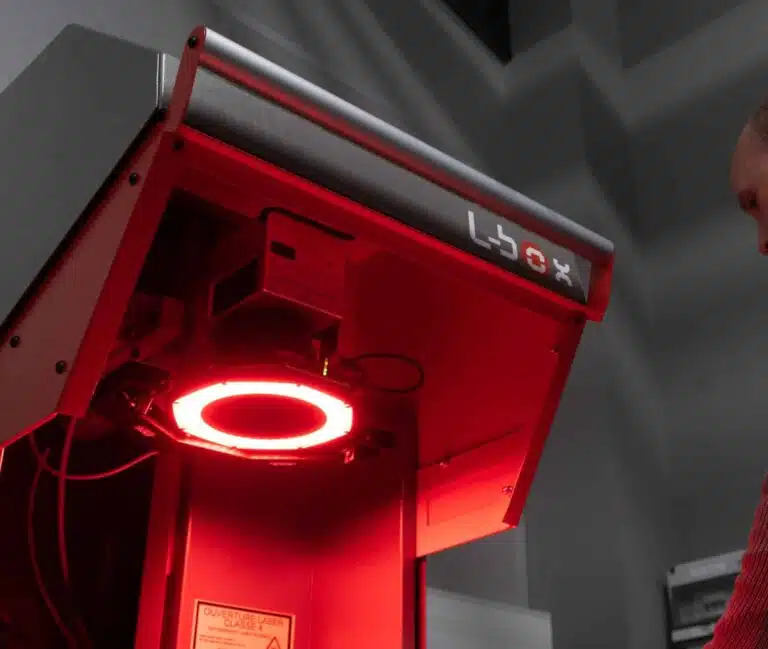
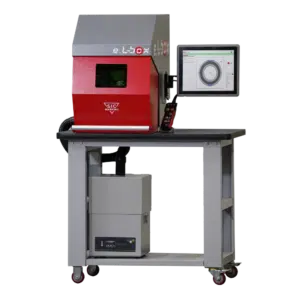
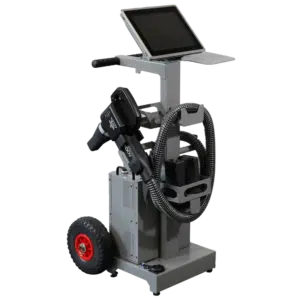
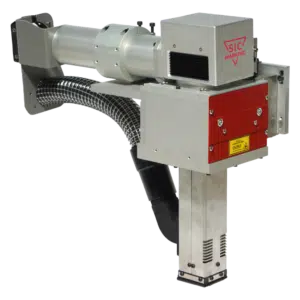
Browse our flagship laser marking equipment, taking in our Portable machines, Line-integrated modules, and Standalone marking stations.
Contact us
Need information?
Speak to one of our experts!