Aluminium is one of the most widely used materials in industry: lightweight, ductile, easy to machine, and available in many surface finishes (raw, anodized, polished, painted).
These characteristics directly influence how it should be marked, depending on the alloy and surface finish.
Its lightness also increases the demand for fast markings adapted to industrial production lines.
All these advantages make aluminium a reliable and cost-effective material for industrial traceability when the marking technology is properly adapted to the application.
SIC MARKING offers a complete range of aluminium marking solutions — laser, micro-percussion and scribing — able to meet a wide variety of aluminium part configurations, from rough-cast surfaces to anodized aluminium housings.
The aluminium marking systems provided ensure permanent and readable markings, whether for 2D traceability, serial numbers or functional markings (machining marks, …). Depending on the chosen marking technology, the marking can favor finesse and visual contrast or mechanical depth and resistance to surface treatments.
The choice of aluminium marking technology primarily depends on the surface finish, the alloy, the part thickness, and the thermal and mechanical constraints related to the application.
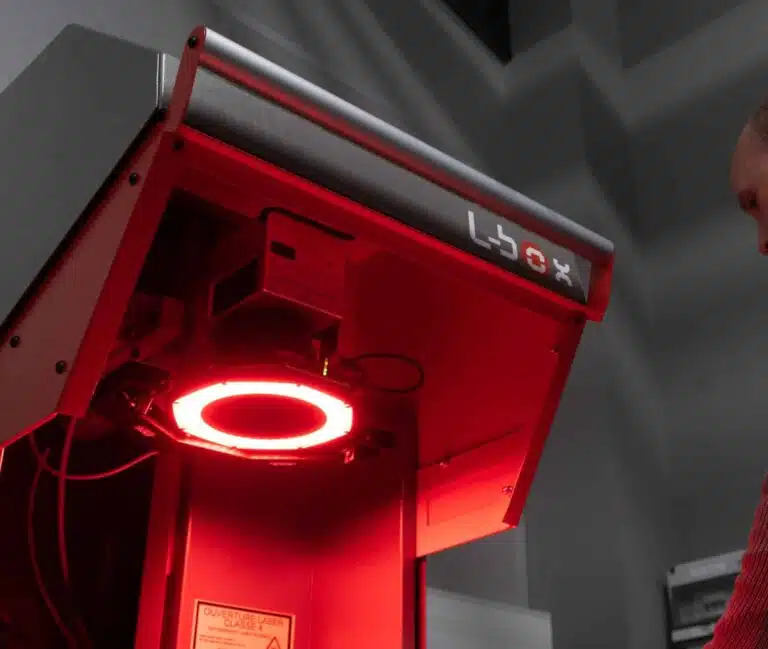
Laser marking of aluminium is particularly well suited to all types of aluminium, regardless of part size or surface finish. It is especially used when visual contrast, fineness, or marking depth are critical, while ensuring no deformation of the part.
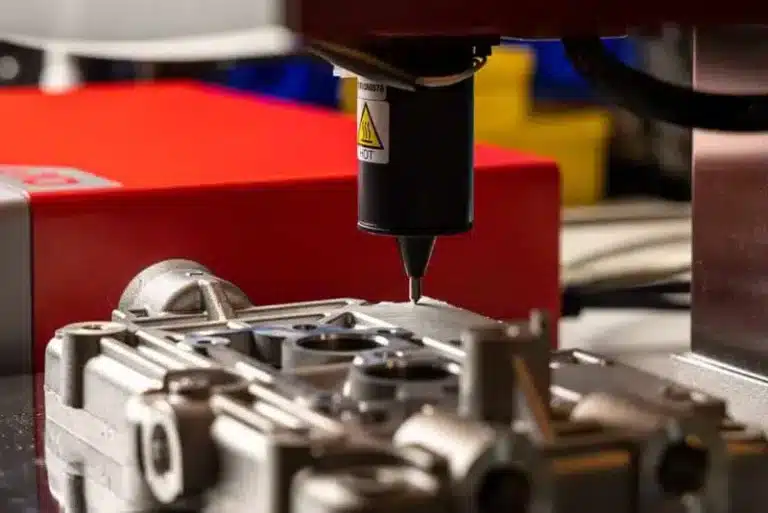
Micro-percussion marking of aluminium is recommended for rough surfaces or applications requiring deep and durable marking, particularly when readability must be maintained after painting, surface treatment, or exposure to harsh environments; these requirements can also be met by scribing or laser marking, depending on the desired level of depth, precision, and contrast.
Scribing marking of aluminium is used when mechanical durability of the marking is the priority, for simple linear markings on solid aluminium parts or thick pieces.
Surface finish
Hardness and alloy
Thickness and rigidity of aluminium parts
Heat sensitivity and thermal conductivity
Contrast level
Aesthetics and readability
The key criteria to evaluate for permanent marking on aluminium are readability, contrast, and the desired marking depth.
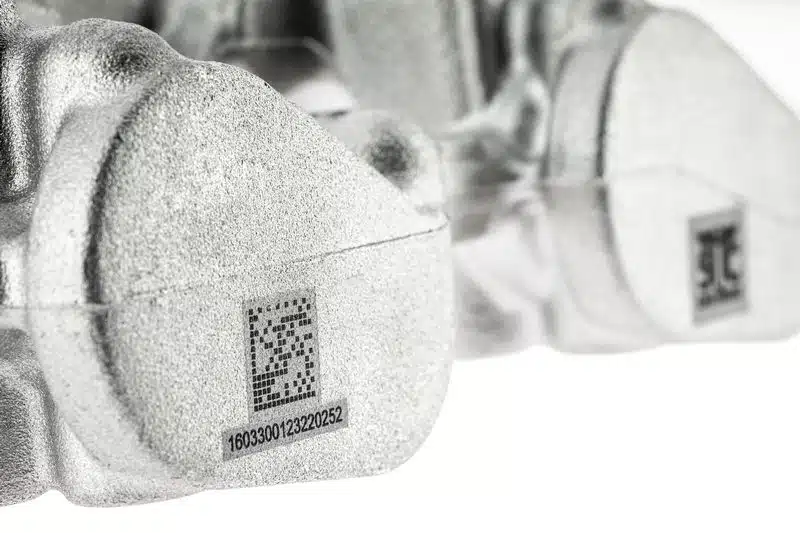
DataMatrix ECC200 remains the standard for industrial traceability: it offers high information density, good error tolerance, and excellent compatibility with aluminium marking, whether anodized or raw, when the process is properly adapted.
Laser marking generates sharp contrast, particularly suitable for machine reading, while micro-percussion creates indented impacts that remain readable even on molded parts or rough surfaces. This type of code is widely required in supplier documentation for the aerospace and automotive sectors to ensure unit traceability.
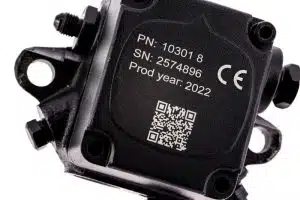
The QR Code, being more visual and less dense, is mainly used for user interaction and maintenance (product sheets, cloud access). It can be marked very effectively with a laser, provided the sizing is appropriate.
In production, the QR Code is often configured with larger modules than those of a DataMatrix to ensure quick reading by smartphone or tablet, even from several tens of centimeters.
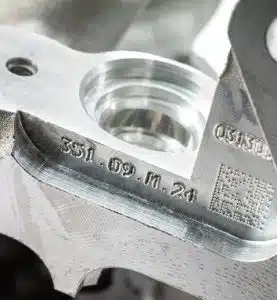
Serial numbers, batch numbers, and other identifiers are ubiquitous on chassis, engine blocks, and machined parts, and must remain readable after wear, cleaning, and inspection operations.
Laser marking allows for fine and high-contrast marking — notably providing clear visual contrast on anodized aluminium — while micro-percussion ensures high durability in dusty, hot, or vibration-prone environments, thanks to its mechanical depth.
Scribing marking is used when the visible engraved appearance or the mechanical durability of the marking is required, particularly for simple linear markings.
For operational traceability, it is common to combine a serial number readable by the naked eye with a 2D code: the operator immediately identifies the visible number, while the scanner verifies the match with the DataMatrix or QR Code marked on the aluminium part.
This dual reading reduces the risk of errors and facilitates rework or product recall operations.
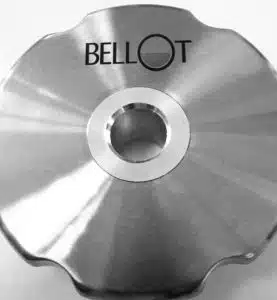
For complex logos and regulatory pictograms, fiber laser marking is generally preferred. It offers high precision and allows the reproduction of fine details, typically on the order of a few hundred micrometers, with high contrast: clear marking on anodized aluminium or high-contrast marking on raw aluminium, depending on the alloy and marking parameters.
When graphic fidelity is essential — manufacturer logos, safety pictograms, micro-texts — laser marking ensures consistent sharpness, even on small elements or fine fills.
Conversely, for rough surfaces (foundry, raw parts) or when a tactile result is desired, micro-percussion is preferred. It produces logos made of indented points, which remain readable even after machining or post-treatment.
Scribing marking of aluminium is used when a engraved appearance and high mechanical durability are desired, such as on plates or decorative elements where appearance and robustness are prioritized over extreme fineness.
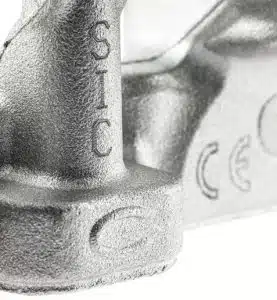
Advanced applications combine requirements for precision, information density, and mechanical durability. They mainly rely on fiber laser marking to achieve fine lines and high contrast, and on micro-percussion when wear resistance and mechanical marking depth are critical.
Specifically, laser allows for high precision, on the order of a few tenths of a millimeter, for graduations and fine text, while micro-percussion can achieve marking depths typically between 0.2 and 0.5 mm, depending on the alloy and settings, for durable markings on structural aluminium parts.
These approaches are commonly used in aerospace, medical, or electronics, where traceability requirements often lead to combining a DataMatrix ECC200 code with metric or functional markers on the same aluminium part.
The choice of aluminium marking technology then depends on the balance sought between optical readability, mechanical resistance, and cycle time, which can range from a few hundred milliseconds to a few seconds depending on the marking density and complexity.
Aluminium, valued for its lightness, ductility, and excellent suitability for surface treatments (anodizing, painting, technical coatings), is particularly well suited for permanent marking by laser, micro-percussion, or scribing.
These permanent marking technologies allow for sharp, high-contrast, or deep markings according to requirements, while ensuring good readability on raw aluminium, anodized, or machined surfaces, when the marking process is adapted to the surface finish.
Thanks to this versatility, aluminium marking meets the traceability and compliance requirements of the automotive, aerospace, agricultural, medical, electronics, energy, and industrial machinery sectors.
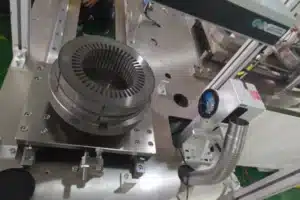


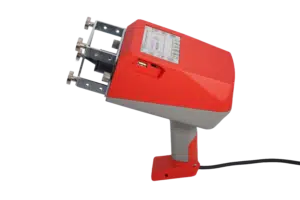
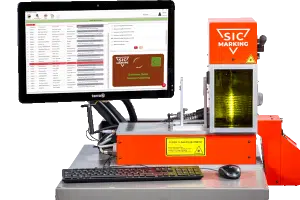
Discover our key laser marking, micro-percussion, or scribing equipment, including Portable Machines, Integrable Modules for Production Lines, or Autonomous Marking Stations.
Contactez-nous
Besoin d’information ?
Prenez contact avec l’un de nos experts !